



Table of Contents
What Is Brand Consistency, Really?
Let’s be honest for a second. “Brand consistency” is one of those corporate phrases that makes people’s eyes glaze over. It sounds like something you’d hear in a boring boardroom meeting.
But if you strip away the jargon, it’s actually very simple. It’s just reliability.
Think about your favorite local coffee spot. You don’t go there because they serve the world’s greatest award-winning coffee every single morning. You go there because you know exactly what that latte is going to taste like before you even walk in the door. That specific feeling—that total lack of surprise—is what builds trust.
When a business feels familiar, it feels safe. And people love to buy “safe.”
The Money Stat: This isn’t just about looking pretty. A landmark study by Marq (formerly Lucidpress) originally found that maintaining brand consistency across all platforms can boost revenue by 23%. But in their 2019 update, that figure jumped to 33%.
Here is the opportunity: Despite that massive financial upside, only 10% of brands report being “very consistent,” and a staggering 81% admit they still struggle with off-brand content. That means the vast majority of your competitors are leaving money on the table—money you can pick up just by getting brand consistency right.
Why Should You Care?
Because if you confuse people, they leave.
Let’s be honest: We’ve all done it. You click an ad because it looks fresh and exciting, but the website you land on looks like a spreadsheet from 2013. You click “back” instantly, right?
That disconnect feels sketchy. It makes the customer wonder, “Is this even the same company?”
If your visuals and tone are all over the place, you look risky. And nobody hands their credit card number to a “risk.” It doesn’t matter if you are chasing millions in VC funding or just trying to sell a few candles on the side—prioritizing brand consistency is the only way to prove you aren’t just making it up as you go along. Looking for consistent signals of professionalism.
The Moving Parts of a Unified Brand
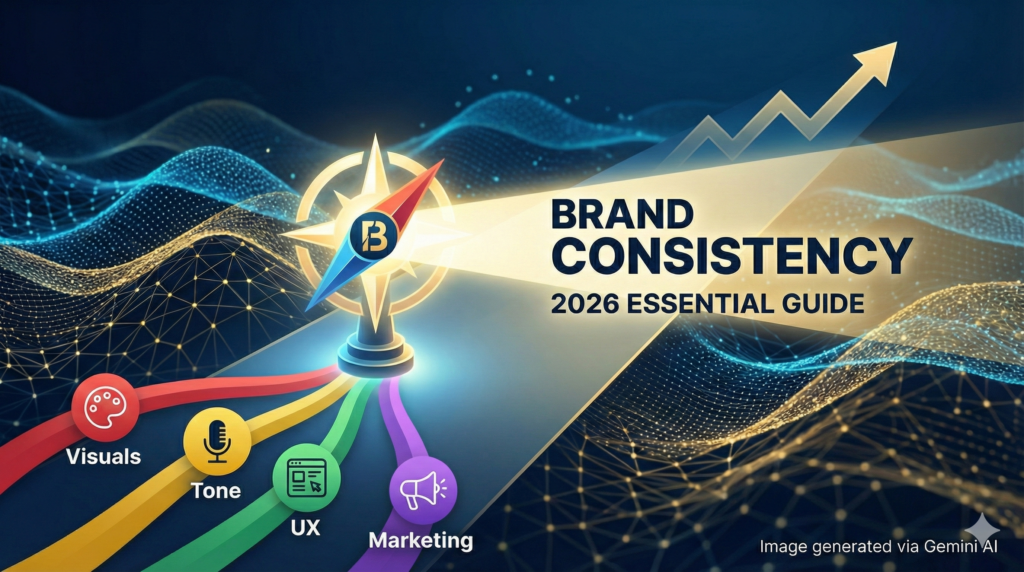
You can’t just slap a logo on a few different images and call it a day. True brand consistency happens when you sync up four specific engines in your business so they are all driving in the same direction:
- Visual Identity (The Face): This is the obvious stuff. It’s your logo, sure, but it’s also your specific hex codes (not just “red,” but your specific shade of red) and your fonts.
- Voice & Tone (The Personality): Are you the funny, sarcastic best friend (like Wendy’s)? Or are you the calm, reassuring expert (like a bank)? Pick one lane and stay in it.
- User Experience (The Handshake): How easy is it to deal with you? If your website is sleek and modern but your checkout process is a nightmare from 1999, that’s a break in brand consistency.
- Marketing Materials (The Outfit): From your business cards to your TikToks, everything needs to look like it belongs in the same wardrobe.
How to Actually Lock This Down in 2026
1. Pick Your Lane (and Stay in It) Before you design anything, decide who you are. Are you premium and exclusive? Or accessible and neighborly? This isn’t fluff—it dictates every decision you make. If you claim to be a “luxury” brand, you can’t be using low-res memes in your email newsletters. It just doesn’t fit the narrative.
2. Stop Sounding Like a Robot. There is nothing worse than a brand that sounds human on social media but sounds like a strict law firm in their support emails. That disconnect is jarring for customers. Ensure your “voice” carries through to every single channel. If emojis are a core part of your marketing voice, leaving them out of your transactional emails can feel like a sudden shift in personality. Keeping the tone consistent helps the purchase feel seamless.
3. The “Playbook” (Visual Standards). This one is non-negotiable. You can’t just send a logo file to your sales team and hope for the best. You need a rulebook. Be specific—tell them exactly how much whitespace to use. Otherwise, you are guaranteed to end up with a slide deck where your logo looks like it was stretched sideways in MS Paint. It looks amateur, and it hurts your credibility.
4. The Platform Pivot. Here is the tricky part: You have to be consistent without being boring. Your LinkedIn posts shouldn’t look exactly like your TikToks—the format needs to change, but the personality must stay the same. You are the same person at work as you are at a party; you just speak a little differently. Your brand should work the same way.
5. The Annual Check-up Brands have to change to survive—even Google updates its logo every few years—but the “soul” of the brand has to stay put. It’s a fine line. If you pivot your entire identity every time a new design trend drops, you don’t look modern—you look unstable. And customers don’t buy from unstable businesses.
Who Is Actually Pulling This Off?
The Heavyweights
- BMW: You can spot a BMW from a block away without even seeing the badge. That front grille is a dead giveaway. While other car brands seem to have an identity crisis every few years—completely changing their look to match the latest fad—BMW stays put. They don’t need to introduce themselves; you already know who they are.
The McDonald’s Factor
- McDonald’s: Let’s be real: Nobody goes to McDonald’s for the culinary innovation. You go there because you are tired, hungry, and you don’t want to gamble on a bad meal. Whether you are in London, Tokyo, or New York, the experience feels the same. They aren’t selling you a burger; they are selling you a guarantee that you won’t be surprised.
The Disruptors: Zomato vs. Swiggy
- Zomato vs. Swiggy: The Personality Gap. Zomato effectively quit acting like a corporation. Instead, they adopted the persona of a college friend. Just look at their push notifications. They never feel like polished marketing copy; they feel like texts from a buddy who is frantically craving biryani.
- Swiggy decided to own “efficiency.” They are the apps you open when you just want the job done. Zomato took a weirdly different route: they decided to be funny. They figured out that if they can make you laugh with a random notification, you aren’t just a customer anymore—you’re a fan. It turns ordering dinner into a habit rather than a chore.
Consistency When It Hurts (Crisis Management)
It is easy to have “values” when the graph is going up, and everyone is getting bonuses. The only time those values actually mean anything is when they start costing you money.
- Calm (The App): When Naomi Osaka withdrew from the French Open for her mental health, the internet debated it. Calm didn’t just post a supportive tweet and move on; they stepped up and paid her fine. They put their money where their mouth is, demonstrating that their commitment to mental health involves actual financial support, not just hashtags.
- Tata Group: In a crisis, while many businesses focus immediately on the bottom line, Tata is frequently recognized for prioritizing its workforce and community. This long-term approach builds a layer of trust that is difficult to replicate with just a marketing budget.
Your Monday Morning Hit-List
Insight is great, but execution is what counts. Here is a quick list you can tackle before lunch:
- Find Your Wedge. Figure out the one specific thing you do differently than everyone else. (Please, spare us the “we provide excellent service” fluff—everyone says that). Find a specific angle and make it the first thing people see, every single time.
- The “Broken Record” Strategy. Choose your main message and repeat it until you are absolutely sick of hearing it. You will get bored with your own marketing long before your customers do. In fact, by the time you are tired of saying it, your audience is usually just starting to pay attention.
- The Master Folder. I know you are tired of Slack messages asking for the “high-res logo.” Solve it by creating a single central folder containing all approved fonts, hex codes, and vector files. Make it the law: If it’s not in this folder, it doesn’t exist.
- The Thumb Cover Test. Pull up your latest email on your phone and hold it next to your recent Instagram caption. Now, cover the logo with your thumb. Read them out loud. Is the vibe the same? If one sounds like a corporate lawyer and the other sounds like a teenager, you have a personality crisis on your hands that needs fixing.
The Final Word
Let’s be real: The market is loud. You don’t need to be the loudest voice in the room; you just need to be the one people recognize. Think of the brands you buy from—they are predictable. That’s the secret. Be boringly predictable, stay in your lane, and your revenue will thank you for it. That is the ultimate power of brand consistency.