You’ve defined your High Ticket B2B ICP. You’ve built undeniable B2B Authority. You’ve mastered the art of manual, human-to-human Cold Outreach B2B.
But here is the final, brutal truth: none of that matters if you can’t run it tomorrow, the day after, and for the next five years without losing your mind.
Most founders reach this stage and promptly crash. They treat their growth as a series of heroic, individual efforts. According to Sharkalytics, some businesses only create articles when inspiration strikes and send the occasional manual email when they urgently need to generate revenue. They hope the “leads” will just keep coming. This is not a business; it’s a nervous breakdown waiting to happen. It is the definition of the content treadmill.
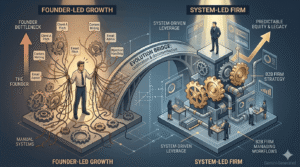
If you want to turn this into a permanent, scalable B2B growth engine, you have to stop “working” and start “operating.” You need to move from random acts of marketing into true B2B Revenue Operations.
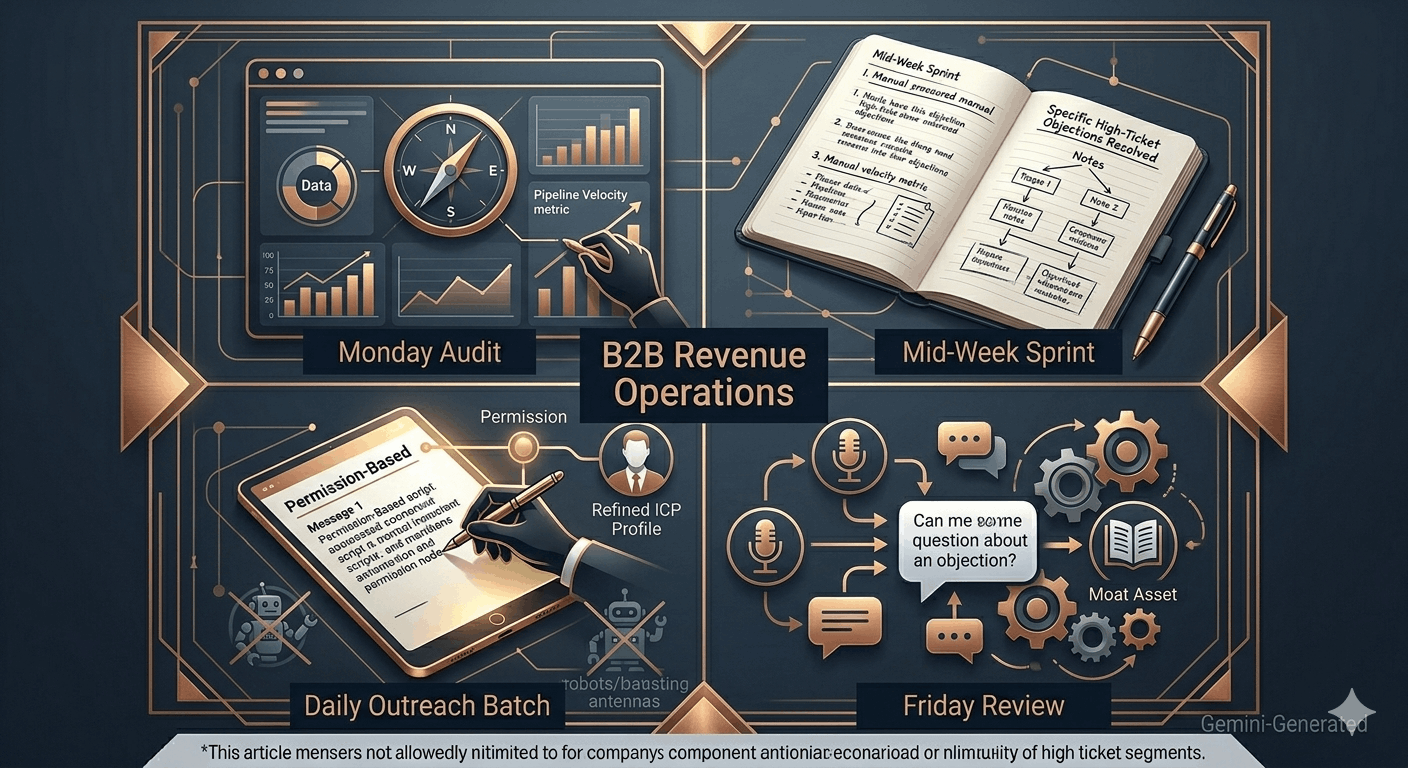
The 4-Step Operational Rhythm
You need a boring, consistent system. If your growth process isn’t documented to the point where a reasonably smart person could follow it, you don’t have a growth strategy. You have a habit. And habits are fragile. Systems are resilient.
Here is the rhythm that stops the burnout and actually grows the firm:
1. The Monday Audit (Data-Driven Calibration)
Stop guessing what’s working. Every Monday morning, spend 30 minutes looking at your metrics. Don’t look at vanity metrics—nobody cares how many “impressions” you got. Look at your Pipeline Velocity. How many manual inquiries were sent? How many “Yes” responses for permission did you get? How many actual calls were booked?
If the numbers are down, you don’t “try harder.” You look at the bottleneck. Is the ICP targeting off? Is the authority asset not converting? According to CegTec, an effective revenue operations framework sets clear measurement standards and responsibilities, so focusing on improving the business system itself is key to driving success. If you skip it, you are flying blind. Most people skip this because they are afraid of the numbers. Don’t be that person.
2. The Mid-Week Content Sprint (Authority Maintenance)
You cannot treat content like a chore you do in your spare time. It is your primary asset. Set aside two hours on Wednesday. That is the only time you write. Focus on one high-value analytical piece that tackles one specific objection from your sales calls.
If you solve an objection in writing, you never have to waste time solving it on a call again. That article becomes a salesperson that works for you 24/7. When you treat writing as a surgical removal of client friction rather than a “marketing task,” your conversion rates will climb. You aren’t “blogging.” You are building a knowledge library that replaces the need for you to be on every single call.
3. The Daily Outreach Batch (The Manual Grind)
Automation is still banned. I don’t care how busy you are. According to Highspot, focusing on making your outreach simple, personalized, and timely ensures each message feels relevant and engaging for your targets. Find one specific thing they did—a recent acquisition, a strategic hire, a new product launch—and lead with that.
Use the “Permission-Based” script we defined in Part 4. This is your most valuable hour. Do not outsource it. Do not automate it. Own it. When a founder receives an email that proves you actually looked at their business, they don’t see a “cold lead.” They see a partner who respects their work. That is the only way to get a meeting. It is slow. It is hard. And that is exactly why it works.
4. The Friday Review (Objection Harvesting)
Each Friday, meet with your sales team to discuss which customer objection or question made prospects hesitate the most on recent calls, since understanding these recurring objections is essential for addressing the issues that often lead to lost B2B deals, according to Kickscale. What objection cost you the deal? Write that down. That objection is your next authority asset. You are effectively building an automated sales deck just by listening to your prospects. If three people ask the same question, write the definitive guide on that question. You are building a knowledge moat around your business. You are teaching your prospects how to buy from you.
Why Predictability is a Competitive Advantage
Your competitors are chaotic. They have good weeks and bad months. They are at the mercy of the “treadmill.” They are reactive, panicked, and constantly chasing the next shiny object. By implementing this operational rhythm, you are doing something your competitors aren’t: you are building equity.
Every manual email sent, every authority asset published, and every objection harvested makes your B2B growth engine more efficient. You are effectively “compounding” your marketing efforts.
The first month of this system will feel slow. It feels like you’re doing a lot of work for little “visibility. According to Stuart Gammon of Highspot, organizations that set clear roles, establish effective lead qualification, develop consistent messaging, and plan for renewals early on can build strong B2B revenue systems that consistently generate qualified opportunities and drive predictable growth.” You are manufacturing outcomes.
Closing the Loop: The System IS the Solution
This entire series has been about moving you from the “Content Treadmill” to an automated, system-led operation.
- Pillar 1 gave you focus.
- Pillar 2 gave you trust.
- Pillar 3 gave you entry.
- Pillar 4 gives you sustainability.
You now have a system that doesn’t rely on your mood, your “motivation,” or the latest AI hack. You have a professional service firm that runs on logic.
Go build it. And if you get stuck? Go back to the beginning. Audit your ICP. Sharpen your authority. Clean up your outreach. The system is the solution. Most people are too lazy to do this. They want the “hack.” They want the shortcut. By doing the work, you are already ahead of 99% of your market. Stay the course, keep the rhythm, and watch your revenue grow.
It won’t happen overnight. But it will happen. And once it does, you’ll wonder how you ever survived the “treadmill” in the first place. You are not just building a business; you are building a reliable machine that delivers value to the market and profit to your bottom line. That is the power of true B2B Revenue Operations.